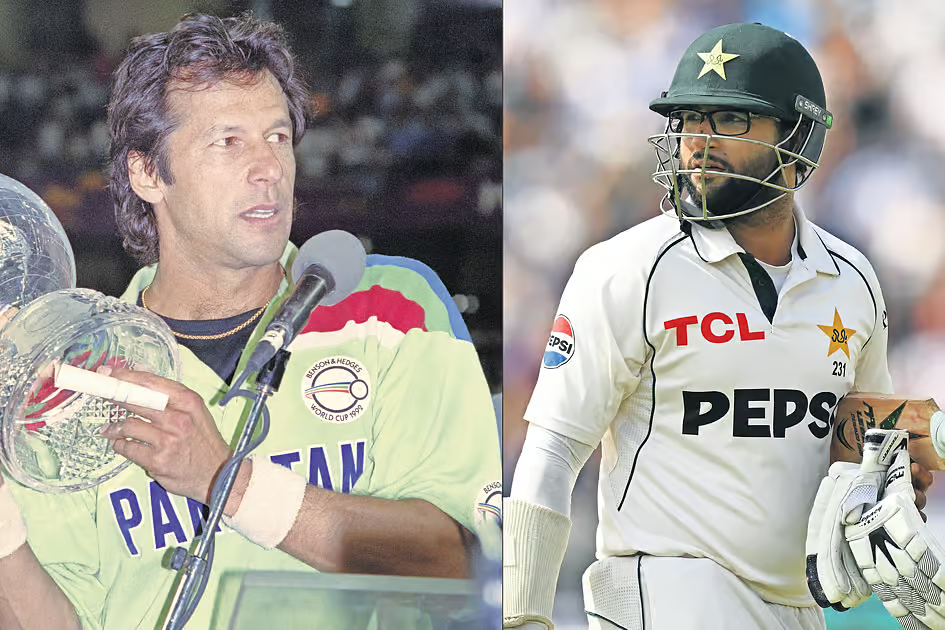
Tariq Butt, a veteran UAE-based Pakistani cricket official who was part of the admin teams at Sharjah Cricket Stadium when the iconic venue hosted some of the most famous international matches in the 1980s and 1990s, has been a quiet observer of how the Pakistan cricket team thrived amid chaos.
For several years, the team was plagued by dressing-room rifts and the occasional incident in which some players reportedly crossed the line and got into fist fights with teammates.
Despite the feuds, what never changed back in the day was Pakistan’s ability to put up a collective fight on the field.
There was a period between the mid- and late 1980s when Pakistan pushed even the mighty West Indies to their cricketing limits.
Now, as news emerged from England of the unprecedented decision to send as many as seven players home and sack head coach Sarfaraz Ahmed in the middle of a Test series following Pakistan’s back-to-back demoralizing defeats, the glory days of the country’s cricket in the 1980s and 1990s seem like an era that will never be replicated.
It’s been a long time since Pakistan last looked like genuine world-beaters in cricket. Their white-ball teams can still produce a string of decent performances, but their red-ball side has clearly hit a nadir.
Having lost eight out of 11 Test matches abroad since 2023, including an embarrassing 2-0 whitewash in Bangladesh, heading into the England series, nobody expected Pakistan to challenge the home team in English conditions.
But the manner of their defeats — Pakistan failed to reach 200 in any of the four innings they played in the first two Tests — left many former English players wondering if this was the worst Pakistan team ever to have played in England.
Barring Mohammad Abbas, their bowlers looked average at best, and their batters were clueless against the moving ball.
Seeing the plight of the visitors, Michael Vaughan said this Pakistan side was no better than the second-division county teams of England.
If that was not bad enough, what followed was a disaster of epic proportions. The Pakistan Cricket Board’s decision to send seven players back from the tour as punishment for poor performances and sack the head coach and bowling coach Umar Gul before the third Test has sent shockwaves across the cricketing world.
The axe fell on Mohammad Rizwan, Imam-ul-Haq, Salman Ali Agha, Ali Usman, Aamir Jamal, Muhammad Awais Zafar and Khurram Shahzad, and five of these players were replaced by uncapped players for the third Test (September 9-13).
But Tariq Butt, who also played first-class cricket in Pakistan before moving to the UAE, said blaming the players or the coaches alone for the failures will never solve the problems that have crept into the sport.
“I have seen Pakistan cricket and its cricket superstars at close quarters. There have always been problems, ego clashes between those great players. But that never stopped them from playing as a unit, and that was the reason why they were so successful back in the day,” the 73-year-old told the Khaleej Times.
“They had superstars and a great team. But now they are not producing players good enough to be competitive in international cricket. But can we blame the players for the current situation? There must be some problem in the cricket system in Pakistan because of which we are not seeing great young cricketers anymore. And certainly, dropping seven players and sacking coaches in the middle of a series is not going to solve the problem.”
Among all the players who were dropped, Salman Agha was the biggest surprise.
Pakistan’s T20I captain, who led the team in the first Test due to Babar Azam’s injury, was dropped for the second Test before he was asked to leave the team.
As a mark of protest, national selector Misbah-ul-Haq resigned, as the former Pakistan captain said he was never consulted by the cricket board before taking those decisions.
But Shahid Hashmi, a veteran Karachi-based sports journalist, is no stranger to strange events in Pakistan cricket.
“This is quite bizarre to do this kind of shake-up in the middle of a series. But sacking, changing and punishing players after a series debacle is not unprecedented in Pakistan cricket,” Hashmi told the Khaleej Times.
“After a series loss in Australia, the then chairman Ijaz Butt banned greats like Younis Khan and Mohammad Yousuf for life and punished several other players. The bans were later lifted on appeal.”
Hashmi hopes that the cricket board takes wise decisions and finds long-term solutions to the problems that have crippled Pakistan cricket.
“PCB needs to address the system on short-term and long-term strategy,” he said.
“This Board has done some good work at the grassroots level, which will help in the long term, and the strategy to give format-specific central contracts will also be beneficial.”
Sitting on a podcast across the border in India, Rajdeep Sardesai, the renowned Indian political journalist and the son of former Test batsman Dilip Sardesai, admitted to feeling sad about the state of affairs in Pakistan cricket.
“I say it with an element of sadness because among my memories growing up watching this great game was the 1982-83 series, Imran Khan versus Sunil Gavaskar. It was Gavaskar at his best versus Imran at his best. I mean, that was cricket at the very highest level,” Sardesai said.
“All that’s gone now. I mean, there’s the politics between the two countries that prevents us from playing each other. But the quality of cricket from Pakistan is just awful.”
For every true cricket lover, it is painful to see a country that produced Imran Khan, Hanif Mohammad, Wasim Akram, Javed Miandad, Zaheer Abbas, Abdul Qadir, Inzamam-ul-Haq, Waqar Younis, Mohammad Yousuf, Younis Khan, Saqlain Mushtaq, Saeed Anwar and Shoaib Akhtar — a remarkably long list of iconic stars — now struggling to put together 11 decent players capable of competing at Test level.
Pakistan cricket has always been chaotic. But there was a time when they found a way to turn that chaos into a competitive force, one that could even challenge the seemingly invincible West Indies.
For more than two decades now, the West Indies have been reduced to rubble. The onus is on Pakistan now to avoid repeating the mistakes of the fallen giants.
Source: Khaleej Times