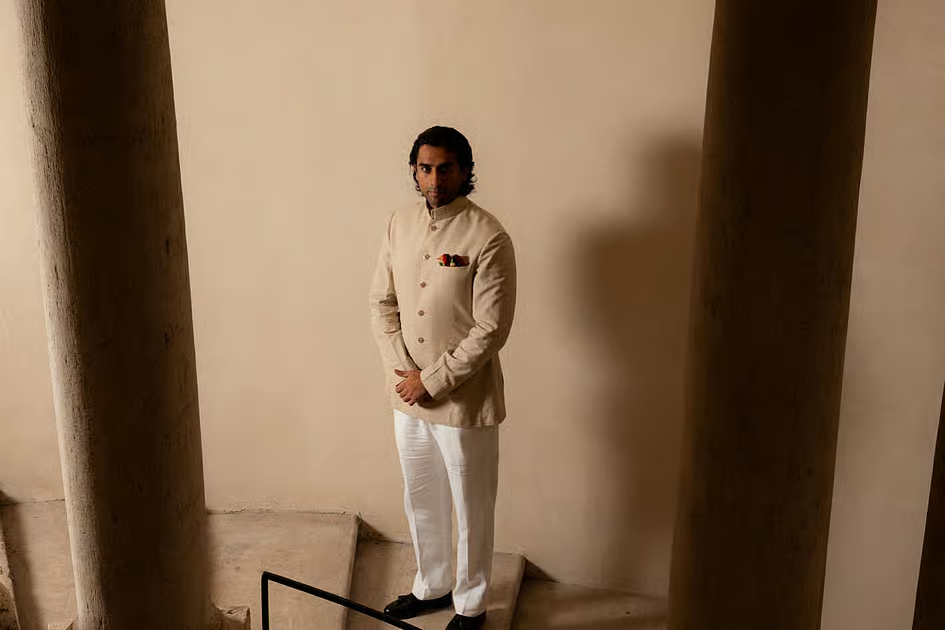
At 8:47 pm in the lawns of Rajasthan Polo Club, the polo is over but the conversation isn’t. Sawai Padmanabh Singh, the Maharaja of the erstwhile royal family of Jaipur, is still in his match kit—the multicolour Jaipur jersey, white breeches scuffed with dirt and the happiness of finishing a successful match.
For someone born into 300 years of history, he is remarkably grounded.
At Khaleej Times, we asked him what this moment means for Jaipur, a city built by his ancestors, which is now reclaiming its place on the world polo map. Jaipur is also the capital of the northwestern Indian state of Rajasthan and one of India’s key cities.
“It’s very special for all of us. It was one of the most genius moves by any Indian ever. Maharaja was one of the most incredible contemporary and genius minds any Indian ever had,” he says with a pause. “Yes, 300 years ago and it’s really an honour for us. I hope we can celebrate it with the right kind of respect and innovation.”
Singh is referring to Maharaja Sawai Jai Singh II, who founded Jaipur in 1727. Jai Singh was also an astronomer, mathematician, and builder of the Jantar Mantar observatories. As Jaipur approaches its 300th anniversary, that balance of respect and innovation is what Padmanabh Singh wants to bring to the sport his family made famous.
Born on July 2, 1998, Padmanabh Singh is the grandson of the late Maharaja Brigadier Sawai Bhawani Singh and Rajmata Padmini Devi, and was adopted as heir to the Jaipur gaddi in 2002. Educated at Mayo College, Ajmer, and Millfield School in England, with further studies in art history and fashion, he became titular Maharaja in 2011. But his own crown has been earned in the saddle.
Passion for polo
Lovingly known as Pacho, he is India’s best-known young polo player, has captained the Indian national team, and plays the high-goal seasons in the UK and Argentina. When asked if polo can still be called an Indian sport, his answer is unequivocal.
“It absolutely is. It’s the Indian sport. India has given this to the world. India is one of the few countries which has played it for more than a thousand years actually,” he said.
And Jaipur, he reminds, was its global capital.
“Right here in Jaipur, we have had some of the most incredible polo players in the world that have come from our city. Some of the most incredible personalities from the world have come to Jaipur on the backdrop of polo.”
That is not nostalgia; it’s history. In the 1920s and 30s, under his great-great-grandfather Sawai Man Singh II, the Jaipur team was the most dominant and glamorous in the world. They won the British Open, the World Cup, and the hearts of Hollywood. The Rambagh Polo Ground was the place to be seen.
Polo tournaments in are bringing a new generation — entrepreneurs, creatives, and Gulf-based equestrian enthusiasts — back to the field, which brings him to his mission statement: “So the idea is that we can continue to promote and hopefully we can regain some of the glory years that we experienced in the sport in the 1930s.”
It’s a vision that connects past and future. For the UAE, where polo is a winter institution, Jaipur offers not just talent but heritage. For Jaipur, the Gulf offers a modern model of how to make heritage sport commercially vibrant and globally visible.
As the interview wraps, Padmanabh Singh is asked for one more photo. He obliges with a warm smile. There is no entourage clearing the crowd. That, perhaps, is the real shift — being a Maharaja in 2026 is not about ruling. It is about representing: a 300-year-old city and a legacy that still has more to play for.
If anyone can bring Jaipur back to centre field, it is this Polo Prince.
Source: Khaleej Times