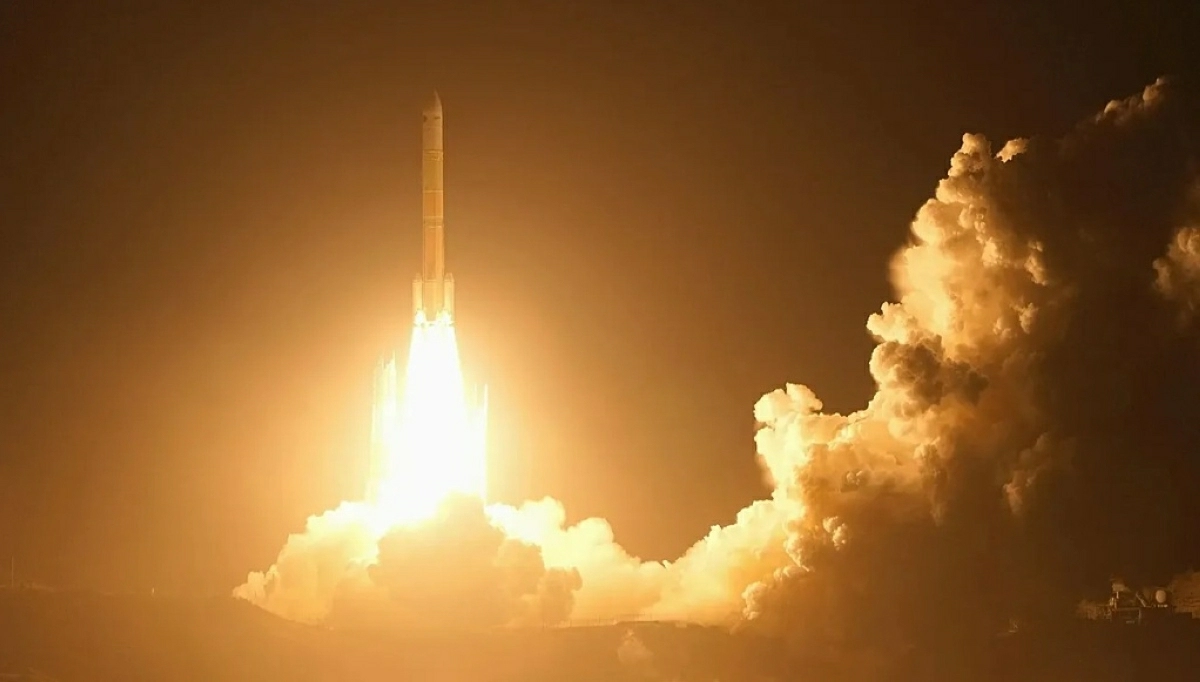
TOKYO — A spacecraft has launched from Japan on a first-of-its-kind journey to Mars, where it will try to land on the planet’s moon Phobos and bring a piece of it back to Earth.
If successful, this will be the first time a sample has been returned from Mars or its moons for analysis in laboratories here on Earth.
The Japan Aerospace Exploration Agency, which is leading the effort, launched the spacecraft before dawn on Tuesday from the main spaceport on Tanegashima Island, with officials declaring success an hour later, when the spacecraft separated as planned from the rocket’s upper stage.
Flight controllers burst into applause, shaking hands and embracing each other.
It is hoped that the Mars Moons Exploration (MMX) mission, which is led by the Japanese Space Agency, will solve the mystery of how Mars’s moons formed.
Prof Sara Russell, from the Natural History Museum, who is the MMX mission’s deputy for sample analysis, said: “There hasn’t yet been a successful mission to go to Phobos and bring a bit back to Earth.
“I think this is an incredibly ambitious and fun mission,” she said.
“When we get the sample back, we’ll be able to look in detail at its chemistry and its mineral composition — and the two hypotheses will produce very distinct results,” said Sara Russell.
“It should be pretty much immediately obvious … whether it’s the product of this dramatic impact or whether it’s a captured asteroid. So we’ll find that out really quickly.”
The team is also hoping there might be an extra bonus coming back to their labs.
“One of the really exciting things is that Phobos is so close to the Mars surface that whenever there’s an impact into the Mars surface, little grains might actually become implanted into Phobos itself,” said Russell.
“And that means that the sample we get back may actually contain grains of Mars as well. So it can give us really direct information about the composition and history of Mars.”
The spacecraft is scheduled to arrive at Phobos in August 2027.
Five space agencies are backing the five-year mission, which will put a robotic sample collector and a small rover on Phobos, the larger and nearer of Mars’ two tiny moons.
The $578 million mission centers on a 5-ton spacecraft expected to reach Mars by late next summer. It will match Phobos’ tight orbit before releasing Idefix, a French-German rover named after the white terrier in the Asterix comics.
No bigger than a microwave oven, Idefix will drop onto Phobos on its own, bouncing for several minutes before stopping in the moon’s extremely low gravity.
“There’s a lot of adrenaline and a lot of excitement and a lot of wow,” said NASA astrophysicist Tom Statler, who is involved in the project.
NASA has landed nine spacecraft on Mars over the past 50 years, and China touched down in 2021, but no one has ever ventured onto Phobos or its companion, Deimos, and no one has returned samples from Mars, let alone its moons. If successful, dust, soil and rock from Phobos will reach Earth in 2031.
Analysts believe Japan has an edge, having already completed two asteroid sample returns.
Phobos is a lumpy, potato-shaped rock about 22 kilometres across. Studying it could explain how Mars’ moons, and possibly moons elsewhere, formed.
The four-wheeled rover is designed to right itself if it lands upside down. All bets are off, though, if it sinks into soft soil or gets wedged between rocks, said the French Space Agency’s Julien Baroukh. Once the rover’s solar panels are deployed, the vehicle can no longer right itself, he added, which is why it will move at a glacial 1 millimetre per second (0.04 inches per second).
Idefix will serve as a “scout for safety,” according to Baroukh, as it prowls around Phobos for 100 days. Japanese flight controllers want to avoid powdery soil and rough terrain when the mothership — a four-legged stationary lander — descends to the surface to gather samples in late 2028 or 2029.
The lander will spend just two hours on Phobos, drilling and vacuuming up at least 10 grams (one-third of an ounce) of material before launching back into space. It will then study Deimos during a series of flybys, leave the Martian neighbourhood in 2030 and hurry back to Earth to deliver the samples in the Australian desert in 2031.
It is a treacherous undertaking, with wreckage littering the path. The moons’ names are hardly comforting: Phobos is Greek for ‘fear’, and Deimos means ‘dread’. They are the twin sons of Ares, known as Mars in Roman mythology.
Source: Saudi Gazette