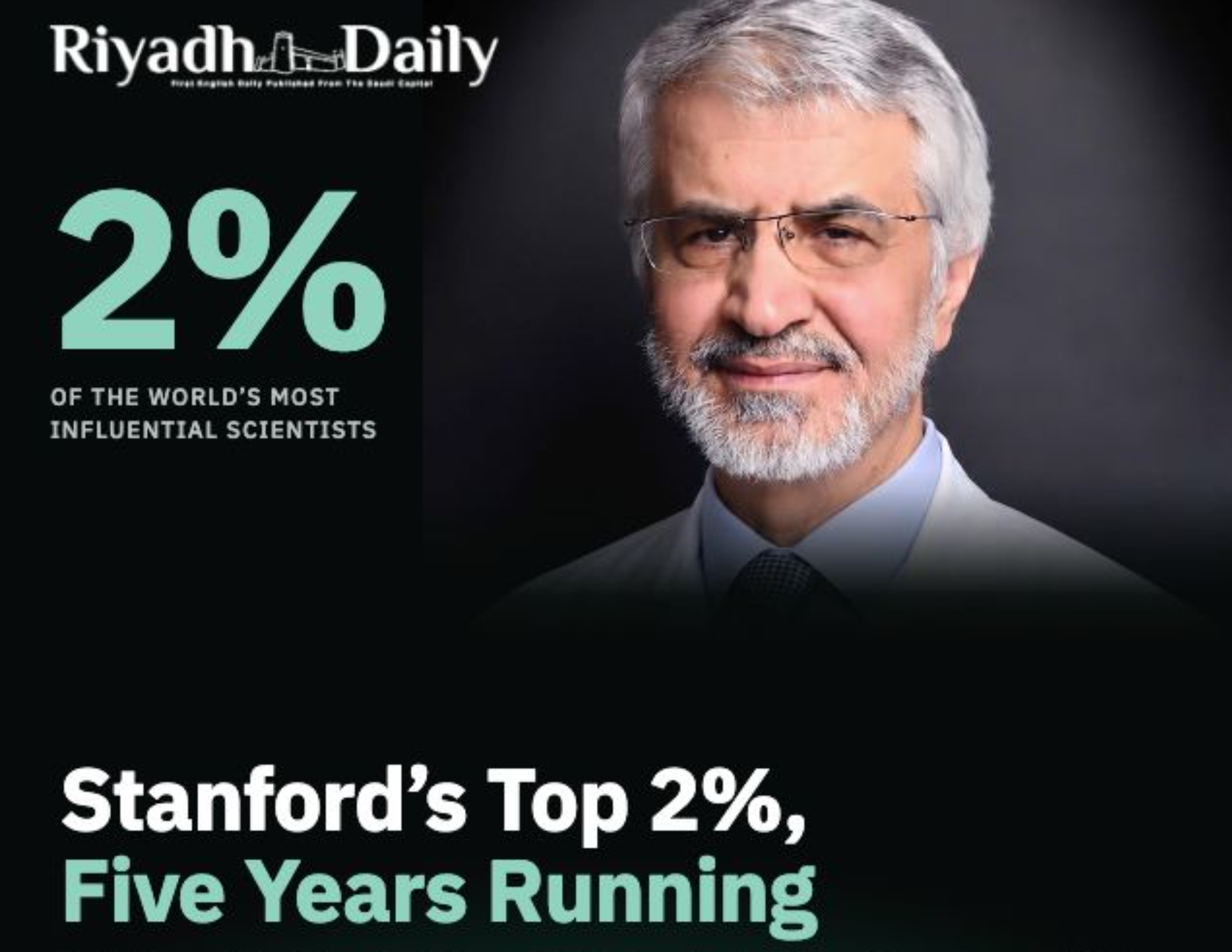
Professor Ahmed bin Ali Al-Qahtani, Principal Scientist at the Research Centre of King Faisal Specialist Hospital & Research Centre (KFSH&RC), has been listed among Stanford University’s top 2 percent of the world’s most influential scientists for the fifth consecutive year, according to the ranking, which weighs the quality of published research and how often it is cited by other scientists.
His repeated inclusion reflects the growing international visibility of Saudi researchers and their contribution to global scientific knowledge.
Al-Qahtani’s career spans more than three decades. He earned a bachelor’s degree in biology from King Saud University in 1984, followed by a master’s degree and a doctorate in molecular biology and cell science from the University of Georgia in the United States in 1990 and 1996. He held academic and administrative posts at King Khalid University and King Saud University before joining KFSH&RC and its research centre in 2005, where he has worked as a lead researcher and chaired specialised scientific committees in the Kingdom and abroad. He has also served as a visiting professor at Leuven University in Belgium and the University of Crete in Greece.
He has contributed to designing diagnostic tests for infectious diseases, most notably a method for detecting the novel coronavirus developed as the outbreak emerged in 2020. Over his career, he has supervised more than 30 master’s and doctoral theses, published about 200 papers in peer-reviewed international journals, and secured research grants worth roughly SAR 15 million.
Source: Riyadh Daily