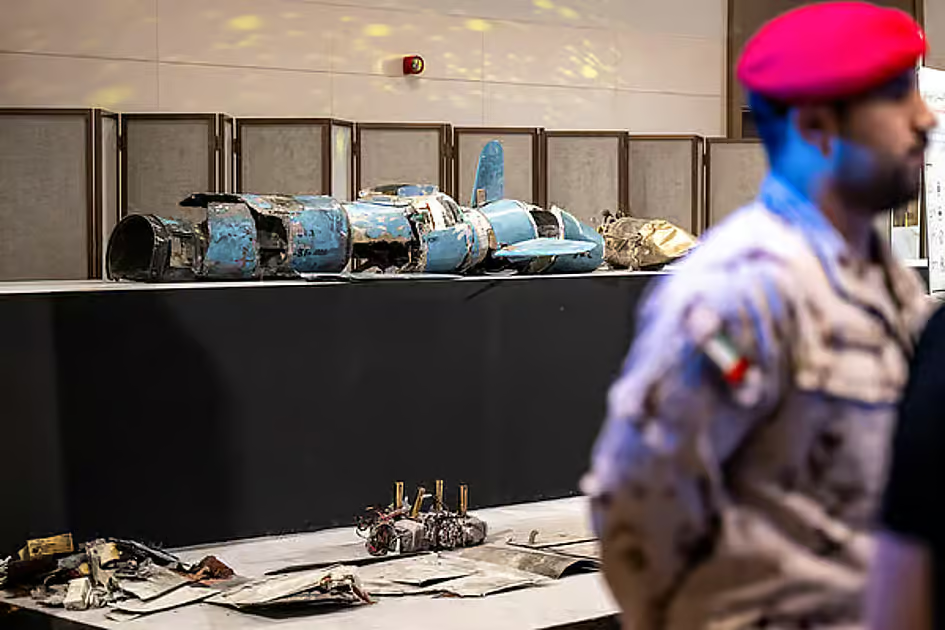
The UAE will take whatever measures are necessary to protect its sovereignty, national security and people if Iran launches further attacks, a senior Emirati official said on Thursday, indicating that all options remain on the table when it comes to responding to threats from Tehran.
Speaking at the UAE Correspondents’ Majlis in Dubai, Dr Ali Rashid Al Nuaimi, Chairman of the Defence, Interior and Foreign Affairs Committee of the Federal National Council (FNC), was asked whether the Emirates would respond if Iran carried out another attack.
When pressed on whether that included responding to an Iranian attack, he replied: “Everything.”
His remarks come after months of regional tensions following Iranian missile and drone attacks on the UAE and other Gulf countries.
The UAE has repeatedly condemned Iranian attacks and asserted its right to respond in accordance with international law. Since the conflict began in late February, the country has faced successive waves of missile and drone attacks targeting civilian areas and infrastructure, including airports, ports and residential areas.
In the latest attack reported by the Ministry of Foreign Affairs on August 31, UAE air defence systems intercepted an Iranian drone over the country’s territorial waters. The ministry condemned the incident as a violation of the UAE’s sovereignty and reiterated that it would not tolerate threats to its security and sovereignty.
Will the conflict drag on like the Russia-Ukraine war?
Dr Al Nuaimi said he did not expect the conflict with Iran to drag on for years like the Russia-Ukraine war, predicting that it could end before the close of 2026.
Asked whether the region was facing a prolonged conflict with periods of escalation and relative calm, he said the situation was fundamentally different from the war between Russia and Ukraine.
However, he did not rule out the possibility of another full-scale war, saying much would depend on the Iranian leadership’s actions, its commitments and the future it envisioned for its people.
Dr Al Nuaimi reiterated that the UAE had favoured a political solution from the beginning, seeking diplomatic engagement and a greater role for regional countries in resolving the crisis.
Before the war broke out in late February, the UAE had taken several diplomatic steps aimed at preventing an escalation. In January, it reaffirmed that its airspace, territory and waters would not be used for military action against Iran, nor would it provide logistical support for such operations.
Despite those diplomatic efforts, the conflict erupted on February 28. The UAE has since maintained that it is not a party to the war and has consistently called for de-escalation and a diplomatic resolution.
Can UAE and Iran rebuild trust?
Dr Al Nuaimi also addressed the prospects of rebuilding trust with Iran, stressing that any improvement in relations would require genuine change backed by concrete initiatives, rather than simply reopening dialogue.
He said the structure of Iran’s regime had already changed since the beginning of the conflict, describing the transformation as a work in progress.
He argued that the Iranian leadership needed to recognise the consequences of its actions, which were being felt far beyond the countries directly involved in the conflict.
The confrontation, he explained, was not simply an issue between Iran, the United States and Israel. Its consequences were being felt around the world, making a change in Tehran’s approach all the more important.
He also drew a distinction between Iran’s leadership and its people, saying Iranians deserved a better life and future. He expressed hope that the Iranian government would change its approach, prioritise the welfare of its people and end their suffering.
He said the responsibility for changing course rested with Iran’s leadership. He did not lay out a formal set of conditions for restoring relations with the UAE.
Source: Khaleej Times