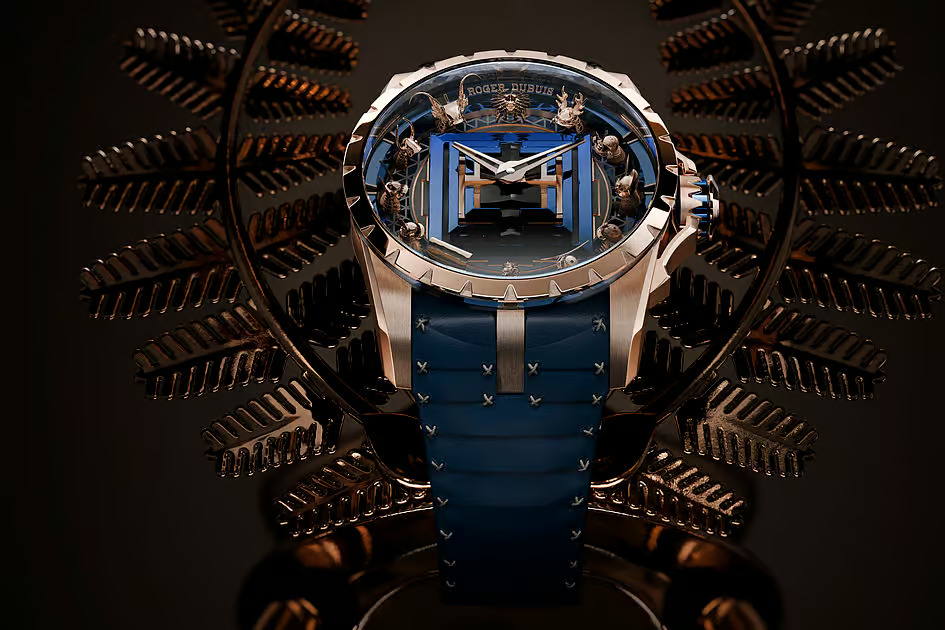
Roger Dubuis has never been particularly interested in disappearing beneath a cuff. The Excalibur The Kabuto Legacy, in 45 mm of pink gold, makes that clear from the outset. It has scale, weight and no shortage of visual drama. But once the first impression settles, a far more intricate story begins to reveal itself.
This story takes us to 17th-century Japan, to a period when prolonged conflict gave way to a new political order and, eventually, more than 250 years of peace and prosperity. Roger Dubuis has chosen this moment of unification as the foundation for the watch, bringing together 12 influential bush, or samurai commanders, around a contemporary interpretation of Edo Castle.
It is a grand subject, and one that could easily have tipped into costume drama. Instead, the dial is handled with a surprising degree of discipline, more like a miniature historical composition than a decorative exercise.
Each hour is represented by a Kabuto — the distinctive helmet associated with one of the commanders. All 12 are hand-engraved in 18K pink gold, with no two alike, and each reportedly takes between two and three days to make. It is in these tiny details that the watch finds its real pull: Tokugawa Ieyasu’s fern-shaped ornament at 12 o’clock; Honda Tadakatsu’s unmistakable deer antlers; Sakai Tadatsugu’s sword-shaped crest; Date Masamune’s celebrated crescent moon. These helmets were never merely protective objects. They spoke of lineage, allegiance and personal identity, which makes them particularly compelling subjects for this kind of miniature craftsmanship.
At the centre sits Edo Castle, although not as a literal reconstruction. Roger Dubuis has interpreted its architecture through a more abstract, contemporary lens, assembling the structure from 17 separate elements. Deep blue surfaces draw on indigo, historically associated with samurai garments and Japanese textiles, while pink gold, black PVD and blue CVD introduce layers of colour and contrast. Bright polishing, circular brushing and shot-blasting bring further texture to the composition, giving the miniature fortress a distinctly architectural presence.
The case itself is substantial at 45 mm across and 16.87 mm thick, and there is little attempt to make it seem otherwise. Nor should there be. This is, fundamentally, a Métiers d’Art creation that happens to tell the time, and a smaller canvas would inevitably have compromised much of the detail that makes the dial worth looking at in the first place. A sapphire crystal ring beneath the bezel allows more light into the composition, helping those engraved helmets emerge with greater clarity.
The narrative continues beyond the dial. The blue calf-leather strap is constructed with stitched, overlapping sections intended to recall samurai armour, while the reverse carries another layer of the story: the 12 commanders’ Kamon, or crests, laser-engraved onto a blue-coated pink gold ring around the sapphire display back.
Inside sits the automatic RD821 calibre, made in-house and certified with the Poinçon de Genève. The movement features 14 distinct finishing techniques, meticulously applied across its components, and operates at 4 Hz, offering a stated 48-hour power reserve.
Just 28 examples will be made.
What ultimately stays with you, though, is the thought behind the dial. Roger Dubuis has taken 12 figures from an age defined by warfare and arranged them in a circle around a symbol of the peace they helped bring about. There is poetry in that idea, certainly, but the watch is at its best when it does not labour the point. Spend a little time looking at those tiny helmets — each with its own character, history and symbolism — and the story begins to unfold on its own.
Source: Khaleej Times