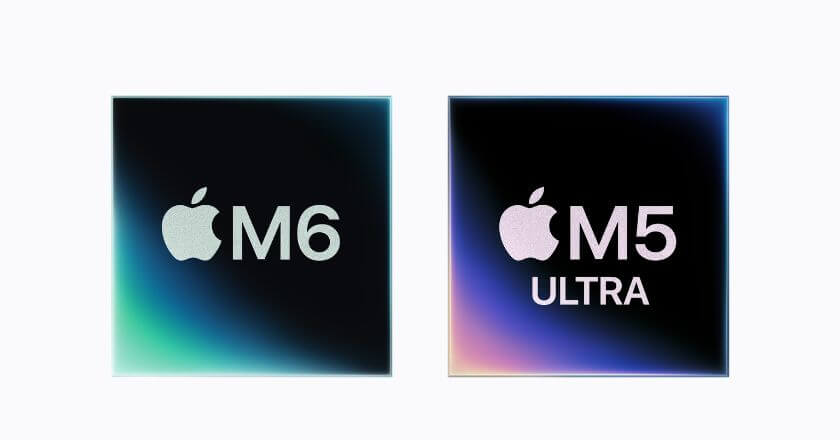
Apple’s first 2-nanometre chip powers faster on-device AI, graphics and everyday computing, while M5 Ultra targets demanding professional and frontier AI workloads
Apple has introduced its M6 and M5 Ultra chips, expanding the performance and artificial intelligence capabilities of its desktop portfolio. The company also unveiled a new Mac mini powered by M6 or M5 Pro, with availability beginning on September 22.
M6, Apple’s first chip manufactured using a 2-nanometre process, features a new 12-core CPU, 12-core GPU, Dual 16-core Neural Engine and up to 170GB/s of unified memory bandwidth. M5 Ultra, positioned as Apple’s most powerful chip to date, introduces the company’s first quad-die architecture for an M-series system-on-a-chip.
The M5 Ultra configuration includes up to a 36-core CPU, 80-core GPU and 1.2TB/s of unified memory bandwidth. Apple said the chip is designed for professional workloads including complex 3D rendering, visual effects, scientific analysis and the local execution of compute-intensive frontier AI models.
“Today, we’re debuting the next giant leap in performance and AI compute for Apple silicon with the incredibly advanced M6 and the most powerful M-series chip yet, M5 Ultra,” said Sri Santhanam, Vice President of Silicon Engineering Group at Apple.
“Built using the cutting-edge 2 nm process, M6 combines a new CPU complex, two additional CPU and GPU cores, a Dual 16-core Neural Engine, and more unified memory bandwidth to power through workloads with amazing energy efficiency.”
M6 advances on-device AI
M6 has been developed for users ranging from students and developers to enterprises and AI enthusiasts. Its 12-core CPU comprises two super cores, four performance cores and six efficiency cores. Apple said the chip delivers up to 1.2 times faster multithreaded performance than M5 and up to 2.4 times faster performance than M1. The architecture is intended to accelerate workloads such as image editing, code compilation, file indexing and agentic AI processing. The Dual 16-core Neural Engine provides up to twice the peak compute performance of previous generations. Apple’s system frameworks can use both engines simultaneously, helping applications execute AI models faster on the device.
M6 also features a 12-core GPU with a Neural Accelerator in every core. According to Apple, the design delivers a nearly 30 per cent increase in peak GPU compute for AI compared with M5 and more than eight times the performance of M1. Updates to the shader core architecture, Dynamic Caching and hardware-accelerated ray tracing are designed to support faster rendering, improved frame rates and more realistic graphics. Geometry-processing performance has also increased by 50 per cent. The chip supports up to 32GB of unified memory and offers up to 170GB/s of memory bandwidth, representing a 10 per cent increase over M5.
The expanded capacity allows users to run local large language models and perform private agentic AI tasks without transferring data to the cloud.
M5 Ultra targets professional AI workloads
M5 Ultra uses Apple’s UltraFusion technology to connect two dual-die M5 Max chips, creating a four-die processor architecture. The interconnect provides more than 4.4TB/s of inter-die bandwidth and enables the four dies to operate as a single processor.
Its CPU features up to 12 super cores and 24 performance cores. Apple claims M5 Ultra offers up to 1.25 times higher single-threaded performance and up to 1.3 times higher multithreaded performance than M3 Ultra.
The chip’s GPU incorporates up to 80 cores, with a Neural Accelerator integrated into each core. Peak GPU compute for AI is up to 4.5 times higher than M3 Ultra and more than six times greater than M1 Ultra, according to the company.
M5 Ultra also features second-generation Dynamic Caching, hardware-accelerated mesh shading and third-generation ray tracing. Apple said these capabilities deliver up to 40 per cent faster graphics performance than M3 Ultra.
A 32-core Neural Engine and upgraded Media Engine support advanced AI and high-resolution video workflows. Dedicated hardware handles H.264 and HEVC formats, alongside four ProRes encode and decode engines and hardware-accelerated AV1 decoding.
Support for up to 512GB of unified memory and 1.2TB/s of memory bandwidth enables large datasets and AI models containing hundreds of billions of parameters to remain in local memory.
Apple’s Core AI, Core ML, Metal and Xcode frameworks will allow developers to access the processing capabilities of both chips. Developers can also run and fine-tune large AI models locally, while distributing workloads across the CPU, GPU and Neural Engine.
Mac mini gains M6 and M5 Pro options
The new Mac mini with M6 delivers up to four times faster AI performance, twice the graphics and storage performance, and 40 per cent faster CPU performance than previous configurations, based on Apple’s testing.
Its 12-core GPU introduces Neural Accelerators to every GPU core for the first time on Mac mini. The system includes 16GB of unified memory as standard and can be configured with up to 32GB.
Apple said the M6 model delivers up to 13.5 times faster large language model prompt processing in LM Studio compared with Mac mini with M1, and up to 4.8 times faster performance than the M4 version.
Mac mini with M5 Pro is aimed at more demanding app development, video production, scientific simulation and 3D workflows. The chip features up to an 18-core CPU and 20-core GPU, with support for up to 64GB of unified memory and 307GB/s of memory bandwidth.
“With a more powerful CPU and graphics, Neural Accelerators in the GPU, and higher memory bandwidth, Mac mini with M6 delivers a whole new level of AI performance,” said Johny Srouji, Apple’s Chief Hardware Officer.
The M5 Pro configuration can also operate as an always-on desktop for AI agents and creative applications. Apple said multiple Mac mini systems can be clustered through Thunderbolt 5 to run larger AI models locally.
Enhanced connectivity and macOS 27
Both Mac mini models support Wi-Fi 7, Bluetooth 6 and 2.5Gb Ethernet, with 10Gb Ethernet available as an option. The M6 configuration includes three Thunderbolt 4 ports, while the M5 Pro version features three Thunderbolt 5 ports. Both models also provide two front-facing USB-C ports, HDMI, Ethernet and a headphone jack. The systems will run macOS 27 Golden Gate, which introduces performance improvements across AirDrop, Safari and network file browsing. A rebuilt search foundation will support Spotlight, Photos and Mail, while refinements to Liquid Glass are designed to improve readability and visual consistency.
UAE pricing and availability
Customers can pre-order the new Mac mini from August 25, with deliveries and in-store availability scheduled to begin on September 22. Mac mini with M6 starts at AED 3,799, or AED 3,399 with education pricing. Mac mini with M5 Pro starts at AED 7,299, or AED 6,899 for eligible education customers.
Source: Tahawul Tech