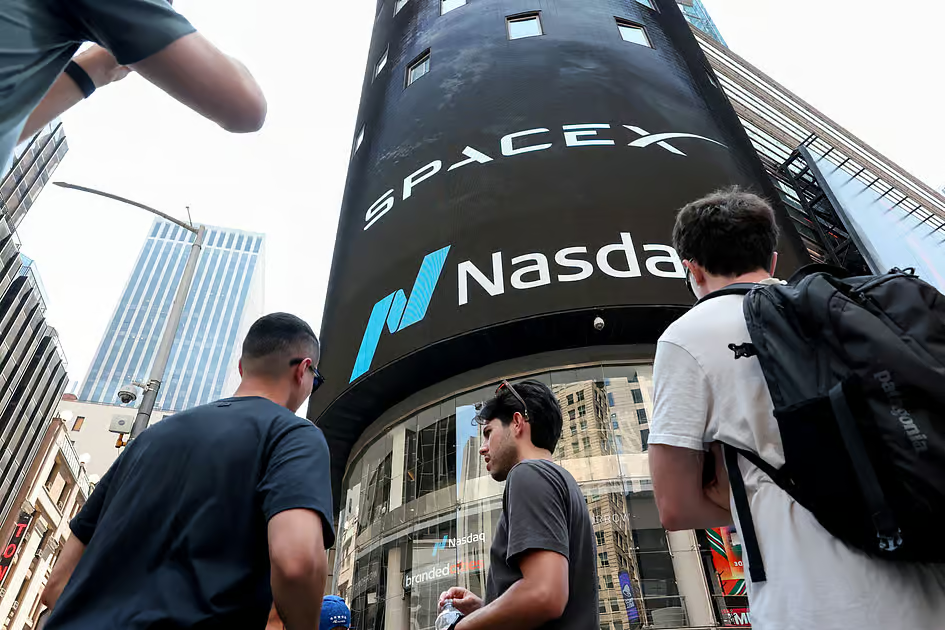
SpaceX shares dropped below their initial public offering price on Wednesday, a first for the company, just over a month after a frenzy over the rockets-to-AI firm powered the biggest IPO ever and made Elon Musk the world’s first trillionaire.
Its shares slid 1.9% to $133.5, falling below the
$135 apiece IPO price and well below the all-time high of
$225.64 that had propelled the company’s market valuation
briefly above those of Silicon Valley giants Microsoft
and Amazon.
The decline leaves investors who bought into the company at
the IPO price sitting on paper losses for the first time,
potentially testing confidence in the stock.
It also offers a reminder that Wall Street enthusiasm can
cool quickly, even for a company with the size and scale of
SpaceX, which raised around $85.7 billion and fetched a
valuation of around $2.1 trillion at the end of its first
trading day.
It is not uncommon for a stock to fall below the IPO price,
especially during periods of broader market stress.
Wall Street’s main indexes have been under pressure in
recent weeks due to uncertainty around the U.S. Federal
Reserve’s interest rate path and concerns about the durability
of the rally powered by AI winners such as chipmakers.
Still, the drop may be a symbolic setback and could bolster
critics who had argued that SpaceX’s valuation was stretched, as
the company lost $4.9 billion last year and many of its
ambitious bets are still untested.
“There hasn’t been anything that lately to remind people of
some of the catalysts for why they bought SpaceX,” said Steve
Sosnick, chief market analyst at Interactive Brokers.
“The fact that a stock has fallen a couple of dollars below
its IPO price in itself is not a tragedy, but SpaceX is heavily
watched and has an important role in investor psyche.”
Investors would find better entry points after the first
wave of excitement had faded, some analysts had warned before
the IPO.
The reversal also underscores the risks of chasing momentum,
and the limits of a valuation driven more by narrative than
near-term fundamentals.
“I think some traders got impatient. They chased the stock,
and it’s rarely a good thing to chase a stock,” Sosnick said.
The stock’s addition to prestigious indexes, such as the
tech-heavy Nasdaq 100, did little to reignite the buying.
SpaceX’s shares have dropped nearly 13% since they were included
in the Nasdaq 100.
The focus now shifts to the company’s first results after
listing. SpaceX has not yet disclosed when it plans to do it,
but has said they will be released only through its website and
its social media account on X, and not through wire
distribution services.
After the report, the first phase of the IPO lock-up period
is set to expire, allowing eligible employees and some early
shareholders to begin selling portions of their holdings, an
event that analysts say could weigh further on the stock.
Investors are also closely watching the company’s 13th
Starship test flight as the rocket’s successful development is
critical to lowering launch costs and enabling many of its most
ambitious long-term projects, including orbital data centers and
lunar missions.
Source: Khaleej Times