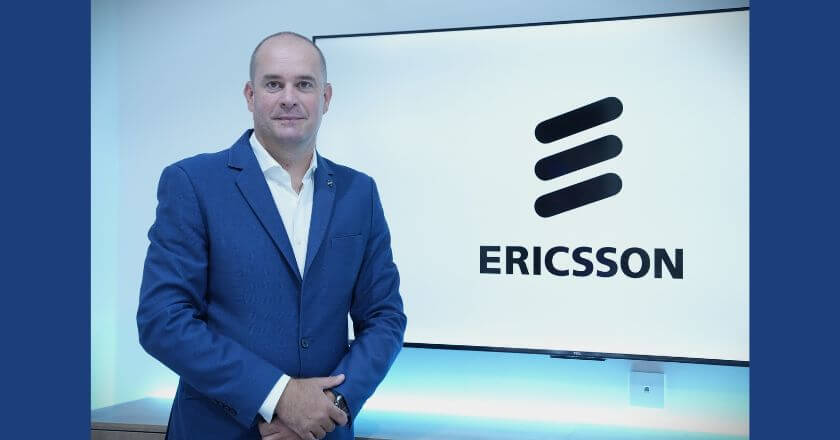
Ante Mihovilovic, Vice President and Head of Networks, Europe, Middle East and Africa, Ericsson, spoke to Tahawultech.com at LEAP 2026 about Saudi Arabia’s rapid digital transformation, the evolution of 5G, AI-powered network automation, cloud-native telecom infrastructure and the technologies shaping the next phase of connectivity.
Saudi Arabia’s rapid digital transformation is strengthening its position as an emerging global technology hub, driven by Vision 2030, growing international investment and an expanding technology ecosystem. Global companies are establishing and strengthening their presence in the Kingdom, attracted by its talent, ambitious digital agenda and accelerating adoption of advanced technologies.
Ericsson is among the companies contributing to this transformation, supporting the connectivity foundations required for an increasingly digital economy. In an interview with Tahawultech.com at LEAP 2026, Ante Mihovilovic, Vice President and Head of Networks, Europe, Middle East and Africa, Ericsson, discusses Saudi Arabia’s growing influence on the global technology dialogue, the evolution of 5G and 5G Standalone, AI-powered network automation, cloud-native infrastructure and the technologies shaping the next phase of telecom transformation.
Interview excerpts
Saudi Arabia is rapidly emerging as a major technology hub. How do you see the Kingdom shaping the global technology landscape?
Saudi Arabia’s transformation is happening incredibly quickly. Vision 2030 has set an ambitious direction for the Kingdom, and you can see changes taking place every day. Saudi Arabia is probably one of the most digitalised countries I have lived in, and I have lived in many countries. There is very little that cannot be done online today, from government services to communications and everyday activities. I can give you a personal example. Where I live, I do not even have fibre connectivity. I use 5G for my daily internet requirements, including streaming and gaming for my children. It demonstrates how technologies we have discussed for many years are already becoming part of everyday life here. What makes Saudi Arabia particularly interesting is the speed at which technology moves from discussion to deployment. Technologies are being implemented and tested very rapidly. LEAP itself demonstrates this momentum. This is its fifth edition, and you can see companies and technology leaders from across the world coming to Saudi Arabia. Ericsson has participated since the beginning, while this is personally my second LEAP since moving to the Middle East two years ago. There is tremendous optimism in the market, much of it connected to Vision 2030. Technology companies, operators and the wider ecosystem are contributing to this transformation.
“Saudi Arabia has established a reputation for being at the forefront of technology adoption.”
How are 5G and Open RAN reshaping network strategies for telecom operators in Saudi Arabia?
5G has opened significant new opportunities for operators to expand into different segments. Connectivity is no longer only about sending messages or making calls. It is increasingly about connecting different aspects of society and industry. This includes mission-critical networks and connectivity across industries, where networks need to remain constantly available and reliable. Particularly during periods of regional uncertainty, resilient connectivity becomes even more important. There is also the consumer dimension. Fixed Wireless Access, gaming and streaming are examples of how 5G is changing everyday connectivity. Many of the use cases that the industry has envisioned for years are now becoming a reality. On the radio side, our Open RAN-ready portfolio gives operators greater flexibility to integrate network components from multiple vendors, helping reduce vendor lock-in. This promotes competition and innovation while giving operators greater choice and control over their network investments.
Saudi Arabia is building the digital foundations for future generations. How is Ericsson contributing to that journey?
We contribute primarily through our technology. If you want to digitalise society, everything relies on stable, reliable and high-performance connectivity. This is where Ericsson has considerable strength. We work across different industries in Saudi Arabia, including with government entities and telecom operators, helping provide the underlying connectivity foundation that enables organisations to introduce new digital services.
How can AI and automation improve network performance, reliability and operational efficiency?
Automation is a key element, but effective automation requires strong processes and a solid network foundation. AI can then be used to enable networks to operate with less manual intervention while improving efficiency, including energy efficiency. This is particularly relevant in Saudi Arabia because the Kingdom has ambitious sustainability objectives connected to Vision 2030. When we discuss networks, we increasingly talk about levels of autonomy. Highly autonomous networks can operate with significantly reduced human intervention. Energy optimisation is one area where AI can make a major difference. Networks contain increasing amounts of equipment, which naturally consume energy. AI can analyse traffic patterns and determine when certain equipment can be temporarily powered down while maintaining the required network performance. One important differentiator is that we can introduce AI capabilities across equipment that has already been deployed over the past five or six years through software updates. Hajj is a good example. We use AI-powered capabilities to steer network traffic during one of the world’s largest annual gatherings, using infrastructure that may have been deployed several years earlier.
“Technology continues to evolve rapidly, but operators can still prepare their existing networks for future use cases.”
What are the key benefits and challenges of adopting cloud-native telecom networks?
The key benefits are flexibility and scalability. Traditionally, individual network functions often required dedicated infrastructure. This resulted in numerous separate systems across the network, each consuming energy and requiring its own operational expertise. With cloud-native architecture, resources can be used according to demand. When fewer resources are required, consumption can be reduced, helping lower both costs and energy usage. When additional capacity is required, operators can scale much more easily. Multiple network functions can also operate on a common platform and share resources. Once everything operates on a common infrastructure, it also becomes much easier to introduce AI and automation.
How can telecom operators modernise their networks while reducing energy consumption and operating costs?
Operators can adopt newer generations of network technology, with each generation delivering improvements in energy efficiency. However, significant gains can also be achieved through software enhancements to the existing installed base. We continue to improve the energy-performance envelope, with meaningful efficiency gains possible year after year. When operators combine those improvements with greater automation and AI capabilities, the potential benefits become much larger.
“AI can optimise how network resources are used, helping operators maintain performance while reducing unnecessary energy consumption.”
What technology priorities will define the next phase of telecom transformation?
The next major evolution will be 5G Standalone. A great deal of focus so far has been on deploying 5G infrastructure, but 5G Standalone opens the door to the full potential of 5G and differentiated connectivity. Different applications require different network characteristics. Gaming may require extremely low latency, while someone working from home needs highly stable and reliable video connectivity. Financial services may require connectivity with particularly strong security characteristics. Network slicing makes it possible for a single network to support these different requirements and deliver differentiated connectivity depending on the use case. I believe we will see significant advances in this area going forward.
Source: Tahawul Tech