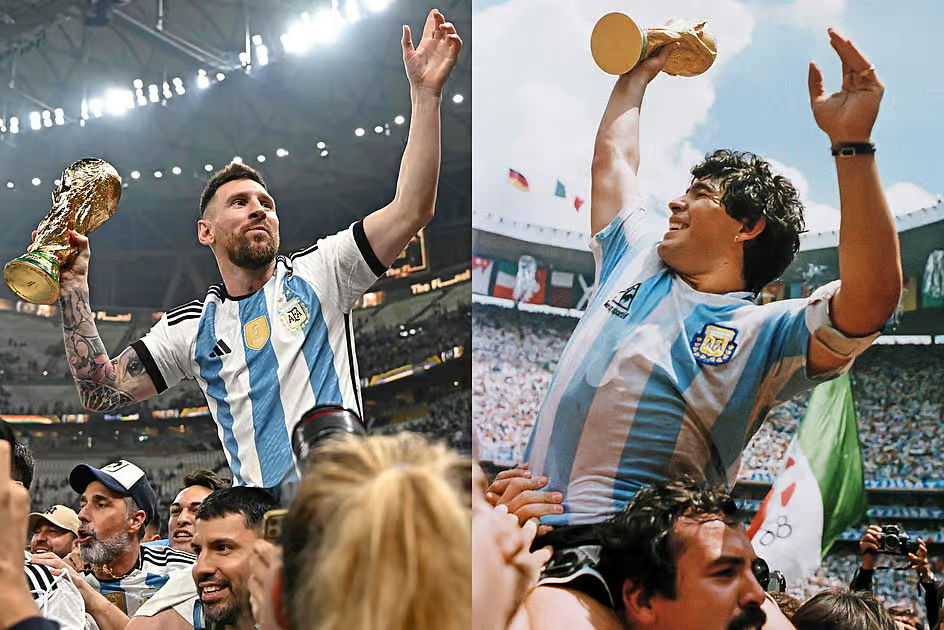
What was hard to miss in Lionel Messi’s farewell message on social media was his strong and deeply emotional emphasis that he always gave his all for the Argentina shirt.
Messi insisted he left everything on the field — in every victory and defeat, from the time he made his senior debut in 2005 to his final appearance last July in the 2026 World Cup final, which ended in a heartbreaking defeat to Spain.
“I swear I always gave everything, not just the last few years when I won everything, before that too, and I always fought and gave everything for this jersey, to bring them joy and make them proud to be Argentinians through football,” Messi wrote.
For more than a decade in Argentina, what was under the scanner was not Messi’s ability as a footballer. With several new Maradonas — Ariel Ortega, Javier Saviola, Pablo Aimar, Juan Roman Riquelme, all technically brilliant players — failing to live up to the exalted public expectations, Argentina had endured several false dawns.
But everyone knew Messi was the real deal the moment he started making the extraordinary look ordinary every weekend for Barcelona.
Finally, football-mad Argentina seemed to have found a precocious teenager who could be the true successor of Maradona.
Messi had Maradona’s low centre of gravity and that rare gift of running and dribbling at full speed with the ball seemingly glued to his magical left foot.
But there was one big difference — the backstory. According to Jonathan Wilson, author of ‘Angels with Dirty Faces: The Footballing History of Argentina’, Maradona fulfilled a 1928 Argentine prophecy that a flawed football genius would emerge from the slums and put Argentina on the world map.
Born in 1960, Maradona did exactly that and more. With bewitching talent on the field and a reckless lifestyle off it, Maradona embodied both sides of Argentina. He remained a fighter who would fall but get up again to chase the ball, even if he was shot in the foot.
Having been raised in a neighbourhood littered with muddy alleys where gunshots often pierced the skies, Maradona developed an unflinching spirit.
He had his flaws, but the history of drug abuse made him only more relatable to the people on the streets. He was not just a football icon who led Argentina to a World Cup triumph in 1986; he was the people’s champion, and a rebel who fought with club presidents and even raised his voice on political issues.
Messi, on the other hand, was the boy every mother would love to claim as her own. He would never make eye contact; his most intimate conversation was always with the ball at his feet.
His early rise had echoes of Maradona’s. At half-time in club matches in his hometown of Rosario, a nine-year-old Messi would entertain the crowd with his breathtaking skills with the ball — just as Maradona had done, juggling the ball at the centre of the pitch at a packed stadium, making national headlines when he was just 11.
But unlike Maradona, who remained integral to Argentina’s football fabric, Messi’s move to Barcelona at 13 slowly erased the public memory of the boy wonder.
When he did announce his arrival on the big stage, Messi was always the Barcelona player who marked his attendance for the national team’s matches.
They questioned his commitment to the Argentine cause as each failure to replicate his astounding club success on the international stage compounded his miseries.
It took him more than a decade to find a place in every Argentine heart. And it took more than trophies to convince Argentinians that he was one of them, not someone who only cared for Barcelona club records.
The 2021 Copa America triumph was the turning point when Messi became more of a leader who would stand up for his teammates, argue with referees and even take on opponents in verbal duels.
He could have never become a rebel like Maradona, but his refusal to give up on his dreams with the national team and his ability to produce age-defying heroics brought an entire country to its feet.
And perhaps the most poignant moment came after Argentina beat Croatia to reach the 2022 World Cup final on the back of another magical Messi performance — just a few days after his Maradona-esque jibe at the Dutch bench following a goal in the ill-tempered quarterfinal clash stunned the world.
Sofi Martinez, an Argentinian television journalist, grasped the pulse of her country when she met Messi after the semifinal win over Croatia.
Instead of asking questions at the mixed zone, Martinez unleashed a monologue on behalf of every single Argentinian.
“I just wanted to say, the World Cup final is coming and sure, we (Argentinians) all want to win the Cup, but I just want to tell you that no matter the result, the fact you resonated with Argentinians, every single one,” Martinez told a visibly emotional Messi.
“There’s no kid who doesn’t have your shirt, no matter if it’s fake, real or a homemade one. Truly you made your mark in everyone’s life and that to me is beyond winning any World Cup. No one else can take that from you and this is my gratitude, for such happiness you bring to a lot of people.”
Messi and Argentina did go on to win the 2022 World Cup with a thrilling win on penalties over France in the final.
But more than the famous trophy, it was the fighting spirit that he began to show in the later stages of his career that finally made him Maradona’s equal.
There was a time when repeated failures — he lost three back-to-back finals (2014 World Cup and 2015 and 2016 Copa Americas) — with the national team and incredible public pressure to live up to the Maradona comparisons reduced Messi to tears.
Now at 39, he is bidding adieu to the famous blue-and-white stripes, leaving his countrymen in tears and with hearts full of gratitude.
Source: Khaleej Times