DUBAI, 28th August, 2026 (WAM) — Dubai Customs brought traders and representatives of the construction materials sector together for a direct dialogue, joined by a select group of leading players across trade, transport, and logistics. The discussion centered on the sector’s key challenges, with participants working toward practical solutions to lower trade costs, speed up shipment movement, and build more resilient supply chains.
Representatives from Emirates SkyCargo, flydubai, dnata, DP World, the Dubai Maritime Authority, Dubai Chamber, and the Emirates Shipping Association took part in the meeting, alongside construction materials traders and representatives and Dubai Customs — enabling direct dialogue among the various parties involved in the shipping process, from ports and maritime and air transport, through clearance and handling, to land transport and shipment delivery, helping address challenges in an integrated way and turn them into clear, actionable pathways.
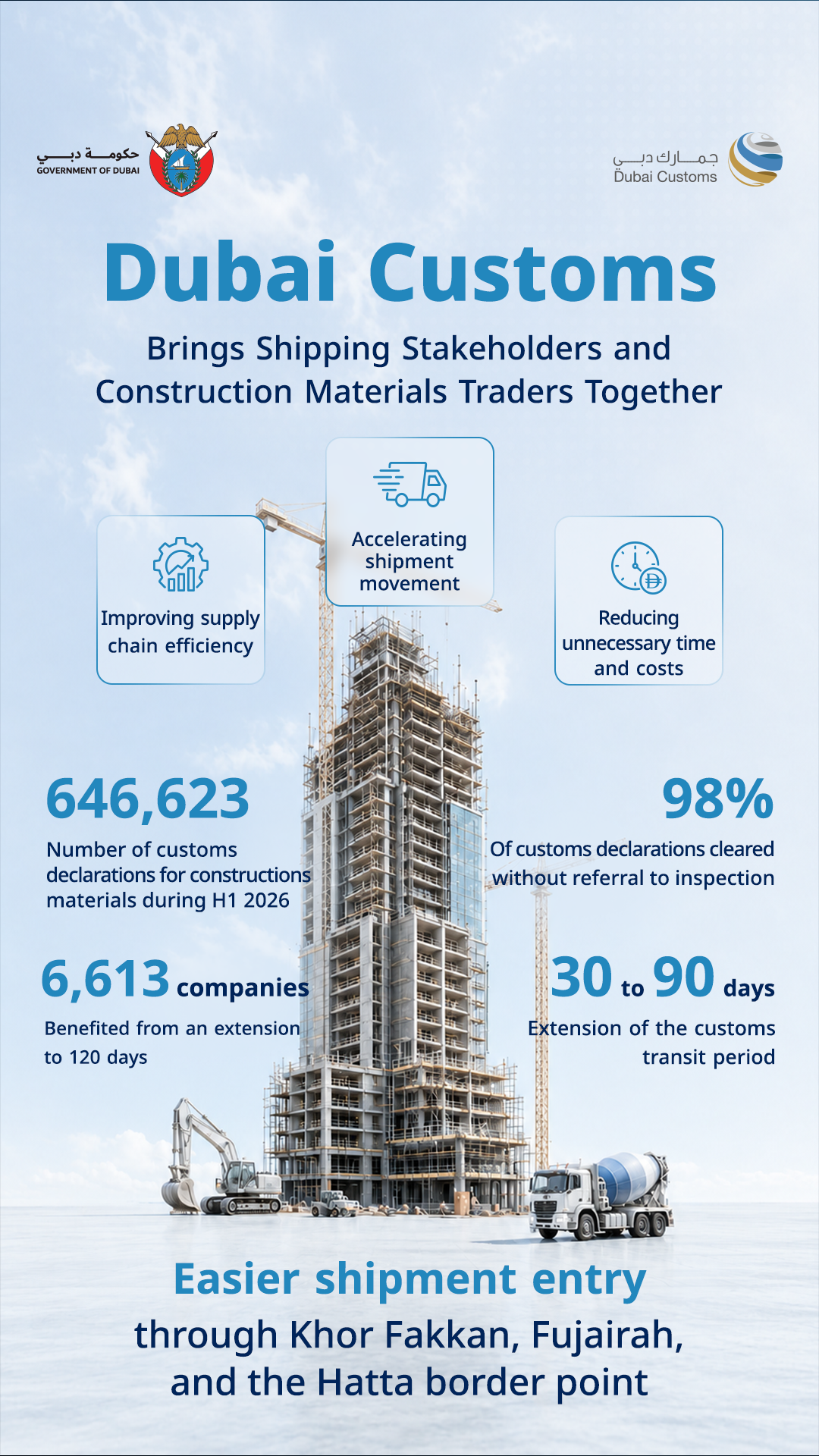
The significance of the meeting stems from the pivotal role the construction materials sector plays in the local economy, as one of the sectors directly linked to urban growth and development projects in Dubai, in addition to its connection to a broad range of trade and logistics activities. According to Dubai Customs data, the number of customs declarations for construction materials reached approximately 1.57 million in 2025, while the first half of 2026 recorded around 646,623 declarations — reflecting the sector’s continued active trade movement and its importance within Dubai’s trade ecosystem.
During the meeting, traders discussed sea freight costs and insurance. The meeting also addressed opportunities to make greater use of air freight, particularly given rising sea freight costs and the shifting cost-time equation across different modes of transport. Traders discussed the potential for more competitive rates on shipments arriving from China via Emirates SkyCargo, in light of some construction materials companies’ need for faster supply and shorter shipment lead times.
Participants also discussed the challenges of transporting chemicals and construction materials classified as Dangerous Goods by air. Airline representatives explained that the ability to accept these shipments, and the permitted quantities, depends on the material’s classification, its UN Number, and MSDS data, along with the safety requirements specific to each category.
Participants agreed on the importance of providing more detailed data on material types, quantities, and sector needs, enabling airlines to assess in advance the feasibility of transporting them based on capacity and flight schedules — turning the challenge into a clear operational mechanism.
Risk Management to Accelerate Trade Movement
Regarding customs inspection, Dubai Customs explained that inspection procedures rely on an advanced risk management system that targets shipments based on a range of indicators, including commodity type, country of origin, source, shipment history, and other risk factors, in addition to random inspections carried out in accordance with regulations.
The organisation noted that around 98% of customs declarations are cleared without referral to inspection, while random inspection rates remain below 1% — reflecting the role of risk analysis and artificial intelligence in reducing unnecessary customs intervention and accelerating trade movement, while maintaining regulatory efficiency and protecting society.
Dubai Customs affirmed that the meeting’s core value lies in bringing supply chain stakeholders together with sector traders at one table, enabling priority challenges to be identified and addressed with the entities capable of resolving them, rather than handling them separately.
The organisation emphasised that the next phase will focus on translating the feedback raised into practical, actionable, and measurable solutions, in collaboration with relevant entities — supporting the continued flow of construction materials, raising operational efficiency, and strengthening supply chain resilience.
In response to regional shifts and developments in global trade movement, Dubai Customs implemented a comprehensive package of facilitations and measures to support company stability, enhance their flexibility in managing their obligations, and strengthen the readiness of the Emirate’s trade and supply chain ecosystem.
The package included Customs Notice No. (12/2026) on extending suspension periods for customs duties, under which 6,613 companies benefited from a 120-day extension for customs declarations covered by the notice — including import for re-export, temporary admission, and transit of all types. These facilitations have provided companies with greater flexibility in managing their customs obligations, boosted cash liquidity, and supported business continuity as well as the smooth flow of trade and supply chains, with the possibility of extending these measures under a subsequent customs notice in accordance with approved rules and procedures.
The package also included Customs Notices No. (14/2026) and (15/2026), which introduced the option to pay customs duties in installments and reduced financial penalties by 80%, along with extending the transit period from 30 to 90 days, and facilitating shipment entry through the ports of Khor Fakkan and Fujairah and the Hatta border point, with land transport under the customs guarantee system, in addition to prioritising the processing of food and pharmaceutical transactions.
These measures confirm that Dubai Customs’ partnership with the business community goes beyond listening to challenges, extending to the development of practical, flexible responses that support companies in facing change — supporting trade continuity and strengthening Dubai’s competitiveness as a global hub for trade and logistics services.
Source: Emirates News Agency