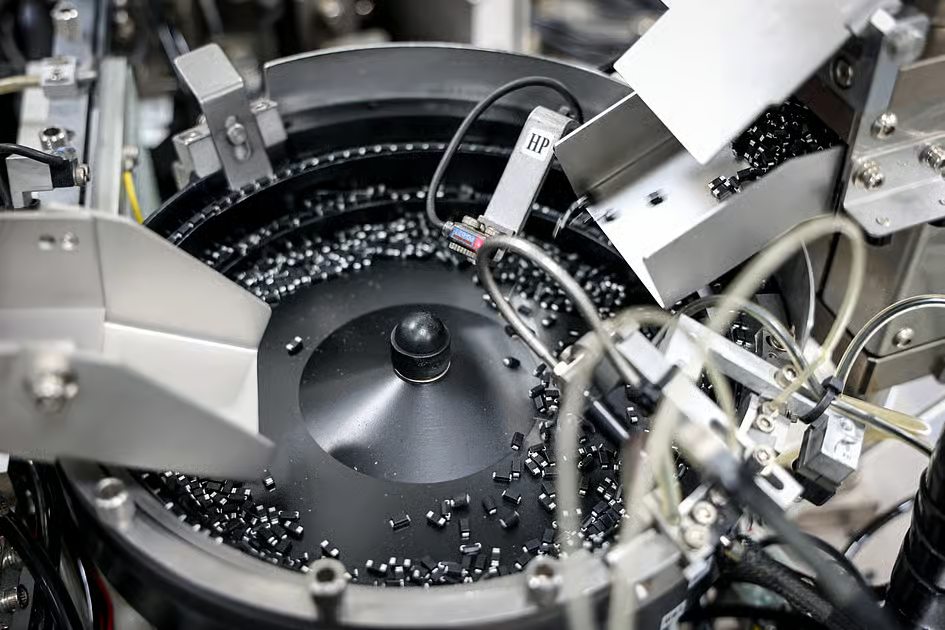
The global AI boom powered Asia’s manufacturing sector in June, with brisk demand for technology-related goods offsetting the drag from the Iran war, business surveys showed on Wednesday, offering some relief for the region’s export-reliant economies.
Price pressures, however, remained elevated as supply shortages and shipping delays lengthened lead times, suggesting the energy shock tied to the Middle East conflict could intensify across the region in coming months.
For now, the surveys underscore how the global AI investment
wave is reshaping Asia’s economic fortunes. Booming demand for
chips, data-centre equipment and other technology goods provides
a powerful engine for growth and acts as a critical buffer
against mounting geopolitical and trade risks.
China, Japan and South Korea saw factory activity expand in
June on solid demand for chips, computers and other AI-related
products, as well as stockpiling by firms seeking to guard
against shortages and price rises from the Middle East conflict.
China’s RatingDog General Manufacturing Purchasing Managers’
Index (PMI) hit 51.7 in June, expanding for a seventh straight
month and exceeding the 50 mark separating growth from
contraction, the survey showed on Wednesday. It eased from 51.8
in May but exceeded analysts’ forecast of 51.6.
The finding aligned with an official survey released on
Tuesday showing China’s factory activity returned to expansion
last month on robust export orders.
“Overall, the manufacturing sector maintained a steady
expansion in June, supported by sustained new order growth,
easing cost pressures and improved labour market conditions,”
Yao Yu, founder of RatingDog, said on China’s PMI.
Japan’s PMI rose to 54.8 in June from 54.5 in the prior
month, expanding for a sixth consecutive month with new orders
growing at their fastest pace in more than two years.
But input cost inflation stayed at a nearly four-year high
in June, a sign of mounting price pressures that could crimp
corporate margins and lead to broad-based inflation.
South Korea’s factory activity expanded for the seventh
consecutive month, though at a slower pace than in May on
falling export demand.
“Firms frequently reported that rising raw material prices,
alongside difficulties sourcing and receiving inputs due to
delays and shortages, weighed on sector performance,” said
Usamah Bhatti, economist at SP Global Market Intelligence.
Factory activity in most Asian emerging economies continued
to expand. The Philippines held steady at 50.9 in June from 50.8
in May, and Malaysia rose to 50.7 from 49.9 in May, the surveys
showed.
Taiwan and Vietnam also saw factory activity expand in June,
the surveys showed.
A separate survey showed India’s manufacturing sector
expanded at its second-slowest pace in four years in June as
export orders suffered from softer demand in Europe.
Source: Khaleej Times